> For the complete documentation index, see [llms.txt](https://docs.flybydev.com/quickstart/llms.txt). Markdown versions of documentation pages are available by appending `.md` to page URLs; this page is available as [Markdown](https://docs.flybydev.com/quickstart/nvidia-orin-nx.md).
# Nvidia Orin NX
Information about the onboard Jetson
## Hardware Specs
The F-11 houses an Nvidia Orin NX 16GB module that delivers up to 150 TOPS for high-performance AI/ML applications per module. By default, each F-11 contains one Orin NX, with the option to run two Orin NX modules on custom order.
The onboard GPU is a 1024-core Ampere architecture GPU, boasting 32 tensor cores, as well as two NVDLA v2.0, an 8-core Arm Cortex-A78AE CPU, and 16GB 128-bit LPDDR5 memory.
| Feature | Description |
| ------------------ | ------------------------------------------------------------------------------------------ |
| AI Performance | 100 TOPS |
| GPU | 1024-core NVIDIA Ampere architecture GPU with 32 Tensor Cores |
| GPU Max Frequency | 918MHz |
| CPU | 8-core Arm® Cortex®-A78AE v8.2 64-bit CPU 2MB L2 + 4MB L3 |
| CPU Max Frequency | 2 GHz |
| DL Accelerator | 1x NVDLA v2 |
| DLA Max Frequency | 614MHz |
| Vision Accelerator | 1x PVA v2 |
| Memory | 16GB 128-bit LPDDR5 102.4GB/s |
| Video Encode | 1x 4K60 (H.265) 3x 4K30 (H.265) 6x 1080p60 (H.265) 12x 1080p30 (H.265) |
| Video Decode | 1x 8K30 (H.265) 2x 4K60 (H.265) 4x 4K30 (H.265) 9x 1080p60 (H.265) 18x 1080p30 (H.265) |
| CSI Camera | Up to 4 cameras (8 via virtual channels\*\*\*) 8 lanes MIPI CSI-2 D-PHY 2.1 (up to 20Gbps) |
| PCIe | 1 x4 + 3 x1 (PCIe Gen4, Root Port, & Endpoint) |
| USB | 3x USB 3.2 Gen2 (10 Gbps) 3x USB 2.0 |
| Networking | 1x GbE |
| Other I/O | 3x UART, 2x SPI, 2x I2S, 4x I2C, 1x CAN, DMIC & DSPK, PWM, GPIOs |
| Power | 10W-25W |
| Mechanical | 69.6mm x 45mm 260-pin SO-DIMM connector |
More information is available in the [Nvidia Data Sheet](https://developer.download.nvidia.com/assets/embedded/secure/jetson/orin_nx/docs/Jetson_Orin_NX_DS-10712-001_v0.5.pdf?QsCHQChuzQNjGTiBSmHMk_vMt2jxbLoLtk08nccfEPcT2HwNgpzizpHMcSYD6QDRXFfDtxcm1l9S7UPkVF8Ub9d9VpJnH56ejjQd0zhGYqdepV6NW9j8C36pxSwFehp6cOjc_qAwLAaqRTzOVyI6K9oVm3Dv8e-g1FHsqkP6gseJT_fDGgY7l8saeRcbEA==\&t=eyJscyI6ImdzZW8iLCJsc2QiOiJodHRwczovL3d3dy5nb29nbGUuY29tLyJ9).
## Software
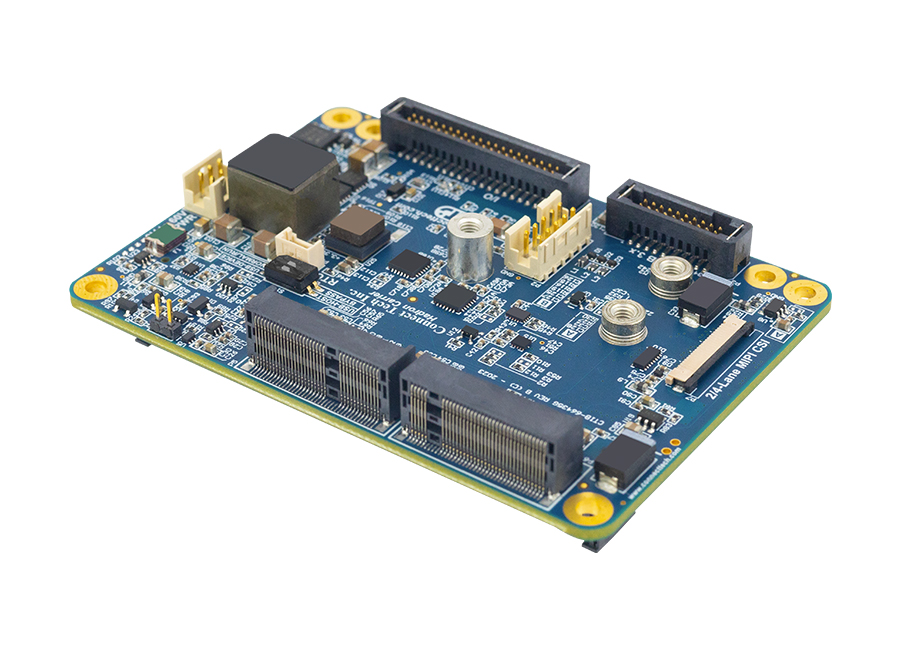
The currently supported Nvidia JetPack version is 6.0, which includes a special board support package (BSP) for the Hadron carrier board. This version comes with Ubuntu 22.04, and is equipped with Gstreamer 1.23. Most Nvidia frameworks and libraries can be preloaded onto the drone on request by contacting Jason, including CUDA and cuDNN.
More Information can be found on the [Nvidia JetPack page](https://developer.nvidia.com/embedded/jetpack-sdk-512).
## Payload Integrations
Currently supported payloads include the Gremsy Vio F1, Sony LR1, Gremsy Pixy LR, GoPro Hero 12 Black, and Raspberry Pi camera V3. More payload and sensor integrations are being developed, and any special requests will be evaluated for potential integrations.
Developers may choose to integrate any payload or hardware that they choose. We are actively implementing a framework for end-to-end payload integration development that will allow users to integrate any payload with ease while allowing full control.
## Mavlink
The Jetson is connected to the flight controller, and therefore the mavlink system, via UART. The baudrate that the this connection expects is 115200. We use mavlink router to communicate with the flight controller. Mavlink router takes over this serial port (`/dev/ttyTHS2`), and exposes a UDP server at `127.0.0.1:50051` and client at `127.0.0.1:50052`. This is exposed through the **mavlink-router** container. More information can be found [here](https://github.com/mavlink-router/mavlink-router).
For development, [MAVSDK](https://github.com/mavlink/MAVSDK) and [pymavlink](https://github.com/ArduPilot/pymavlink) can be used to integrate with the mavlink system. Note that MAVSDK is designed for PX4, whereas our system is built on top of Ardupilot, which may result in some functionality and mavlink messages being slightly different. Pymavlink is designed with Ardupilot in mind.